


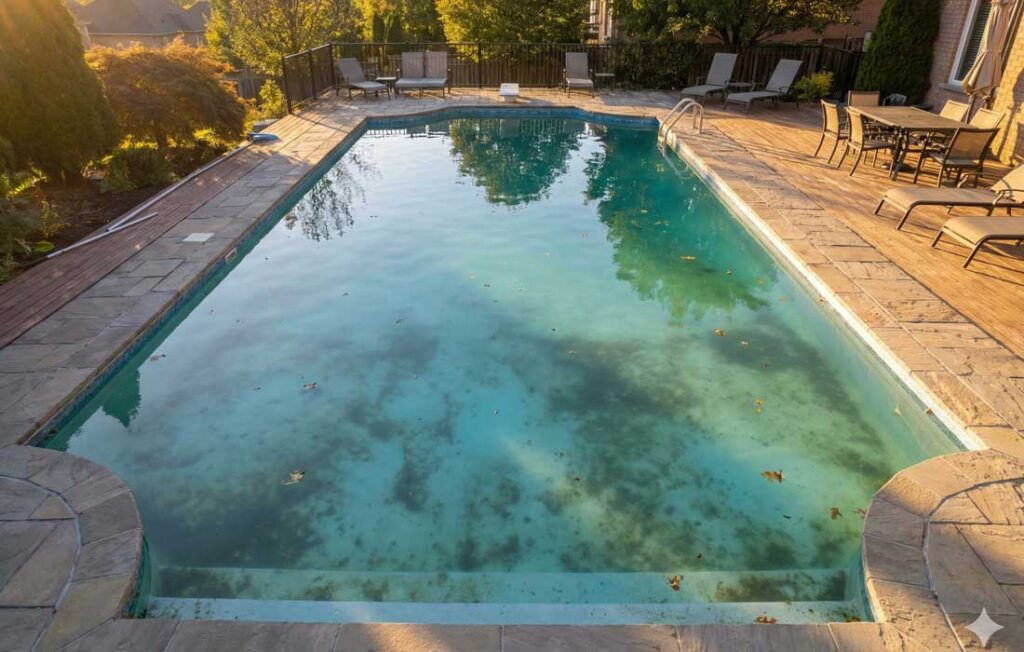
You made a great weekend plan, put on your swimsuit, and stepped into the garden ready to dive into those refreshing waters—but instead of crystal-clear water, you were greeted by a cloudy pool where you can’t even see the bottom, right? Don’t worry, you’re not alone. Almost every pool owner experiences this frustrating situation at least once during the season. In fact, it’s your pool’s way of talking to you. The color, texture, and even the smell of the water are trying to tell you that something isn’t right.
In this guide, I won’t speak to you like a distant expert, but like an experienced friend who has solved this problem many times before. There’s no need to panic; by taking the right steps, we can restore your pool’s original sparkle in as little as 24 hours.
What Is the Most Common Cause of Cloudy Pool Water?
There isn’t a single culprit behind cloudy pool water, but the most common cause is a combination of inadequate filtration, chemical imbalances, and environmental contaminants. Typically, low chlorine levels and a filter that can’t trap fine particles cause the water to lose its clarity.
Let’s break this down. Your pool is like a living organism. If its lungs—the filter—can’t breathe, or its immune system—chlorine—is depleted, it gets sick. If you’re not running your pump for at least 8 hours a day, bacteria and particles start to accumulate in stagnant “dead zones.” On top of that, when the pH balance is off, chlorine becomes ineffective no matter how much you add, resulting in that dull, cloudy appearance.
What Causes Pool Water to Become Cloudy?
The factors that cause cloudiness generally fall into three main categories: low free chlorine levels, chemical imbalances (especially pH and alkalinity), and insufficient filtration time. In addition, external contaminants such as dust, pollen, sunscreen, and body oils also weigh the water down.
When you look closer, you’ll see that the water gives you clues. If calcium hardness is too high, the water may take on a milky appearance as calcium precipitates out. Even if you don’t see visible algae yet, microscopic algae growth can tint the water light green or turquoise. Sometimes the issue is purely mechanical—the filter sand has lost its effectiveness and can no longer polish the water.
How Is Cloudy Pool Water Cleaned?
Before you start, stop panicking and adding random chemicals. First, test the water, balance the pH and alkalinity, then perform a strong chlorine shock and run the filter continuously for 24 hours while using a clarifier.
Think of this process as a battle plan. The first step is always diagnosis. If your pH is not between 7.2 and 7.6, any chlorine you add will be ineffective. Once balance is restored, shock the pool to burn off the organic load in the water. The final strike is filtration—run the filter continuously to remove dead particles and backwash whenever the pressure rises. Fixing cloudy pool water requires patience, not a magic wand.
Is It Safe to Swim in Cloudy Pool Water?
No, it is absolutely not safe. Cloudiness may indicate the presence of harmful bacteria such as E. coli. Additionally, cloudy water prevents you from seeing the pool floor, creating serious safety risks like drowning or injury.
Think about it—if you can’t clearly see the main drain or someone swimming below the surface, entering that water is a major risk. Cloudy pool water isn’t just an aesthetic issue; it’s a health concern. Eye and ear infections are among the most common results of swimming in cloudy water. Postpone the pool party until the water is clear again.
How Do You Clear Cloudy Pool Water After Shocking?
This usually happens because dead algae remain suspended in the water or calcium has precipitated out. After shocking, you should run the filter continuously and use a flocculant or clarifier to bind particles together and drop them to the bottom.
When you shock the pool, you essentially start a major chemical battle. Chlorine kills bacteria and algae, leaving behind dead organic matter that floats as a gray-white cloud. If your filter can’t catch these fine particles, the water may stay dull even if it looks blue. At this stage, using a flocculant to sink the debris and vacuuming it out to waste is the most effective solution.

Pool Water Became Cloudy After Adding Chlorine
When chlorine—especially calcium hypochlorite—is added to water with high pH or high alkalinity, calcium can suddenly become insoluble and precipitate, turning the water white. This is known as “chemical clouding.”
It’s like adding too much salt to a glass of water—after a certain point, it no longer dissolves and the water turns cloudy. If you add chlorine when the pH is above 7.8, calcium separates from the water. In this case, stop adding chlorine and focus solely on lowering the pH. Once balance is restored, the water will clear on its own.
Pool Water Became Cloudy After Algae Treatment
After killing algae with algaecide and chlorine, the remaining dead algae cells turn the water gray or milky. This means the treatment worked, but now you need to remove those dead residues through filtration.
When you treat a green pool, you can’t expect instant crystal-clear water. The pool first transitions from green to a gray-blue cloudiness before becoming clear. At this stage, check filter pressure frequently, as dead algae clog filters quickly. Backwash often to remove these wastes from the system.
Pool Water Became Cloudy After Metal Treatment
Metal sequestrants can cause temporary cloudiness when they react with oxidized metals such as iron or copper. This shows that the chemical is binding the metals and forming particles that will be removed through filtration.
This is especially common in pools filled with well water. If the water turns brown or cloudy after adding a metal remover, that’s normal—it means the product is working. Be patient and keep filtering. However, be careful when cleaning the filter, as trapped metals can re-enter the water if handled improperly.

What Should Be Added to Cloudy Pool Water?
First, correct what’s missing: pH adjuster, shock chlorine, and finally a pool clarifier. If the problem is severe, using a flocculant to drop particles to the bottom can be a faster way to eliminate cloudiness.
Adding pool chemicals randomly is like pouring fuel on a fire. Your test kit is your best friend. If chlorine is low, add chlorine. If pH is high, add a reducer. But if everything is balanced and the water is still cloudy, it’s time for a clarifier. These products act like magnets, binding microscopic particles into sizes your filter can catch.
Pool Water Is Cloudy but Levels Are Fine—What’s the Problem?
If the chemical values are perfect but the water is still cloudy, the issue is mechanical. The filter sand may be channeling or hardened, the pump may be insufficient, or the water may contain particles too fine for the filter to capture.
Sometimes everything looks right on paper, but the water tells a different story. When was the last time you changed your filter sand? If it’s been over five years, the sand edges are likely worn down and no longer trap debris effectively. Poor circulation can also cause cloudiness, especially in above-ground pools where dirt accumulates in corners.
Does Baking Soda Clear Cloudy Pool Water?
No. Baking soda (sodium bicarbonate) does not clear cloudy water; it only raises alkalinity. If added unnecessarily, it can disrupt calcium balance, leading to scaling and even more cloudiness.
This common myth can actually make your pool worse. Baking soda should only be used if total alkalinity is below 80 ppm. If you want clarity, you need shock chlorine or a clarifier—not baking soda.
Can High Alkalinity Cause Cloudy Pool Water?
Yes, absolutely. High alkalinity locks pH at elevated levels and prevents it from dropping. This high-pH environment makes calcium less soluble, causing dull, cloudy water.
Alkalinity acts as a buffer for pH. But when the buffer is too strong, pH becomes uncontrollable. In high-pH water, chlorine works slowly and scaling accelerates, creating that unwanted murky look. To lower alkalinity, use acid (pH reducer) and add it slowly to the pool.
Do Phosphates Make Pool Water Cloudy?
Phosphates don’t directly cause cloudiness, but they are algae’s favorite food source. High phosphate levels encourage rapid algae growth and overwhelm chlorine, setting the stage for cloudy water.
Leaves blown in by the wind, fertilizer dust, and poor-quality source water all carry phosphates. As phosphate levels rise, your pool turns into an “all-you-can-eat buffet” for algae. Even before you see green water, blue-green cloudiness is often driven by high phosphate levels.
Can Cloudy Pool Water Be Harmful?
Yes. Cloudy water provides an ideal hiding place for bacteria and viruses. Eye irritation, skin rashes, and stomach issues can occur. Additionally, swimming in a pool where you can’t see the bottom poses a serious risk of physical injury.
If you can’t see the pool floor, you shouldn’t jump in. For households with children or pets, cloudiness is especially dangerous. Cloudy water is proof of inadequate disinfection—and inadequate disinfection means illness.
Pool Water Became Cloudy After Adding New Filter Sand
New filter sand contains very fine dust from manufacturing. If you started filtering without performing a backwash and rinse after replacing the sand, you’ve sent all that dust straight into the pool.
This is a very common mistake. If your pool water became cloudy after adding new filter sand, those fine silica particles are now floating in your pool. The solution is continuous filtration and frequent backwashing. Next time, always backwash thoroughly before switching the valve to “Filter.”
Will Cloudy Pool Water Clear on Its Own?
No. Pool water never clears on its own; it only gets worse and eventually turns into an algae-filled swamp. Without chemical balancing and filtration, clearing cloudiness is impossible.
Waiting only wastes time and increases cost. That slight haze will turn into green, foul-smelling, foamy water within days. Bacterial growth increases exponentially. Every hour you delay doubles the amount of chemicals needed to fix the problem.
The Difference Between Clear Pool Water and Cloudy Pool Water
Clear pool water reflects light, shines, and allows you to see even the smallest screw at the deepest point. Cloudy water is dull, absorbs light, destroys depth perception, and looks flat due to suspended particles.
The difference is like night and day. In a healthy pool, the water reflects the blue of the sky and feels inviting. Cloudy water looks lifeless. If you struggle to see the patterns on the pool floor or notice the color shifting from blue to gray, you’re clearly experiencing the difference.
Pool Water Became Cloudy After Rain
Rainwater is acidic, lowers the pool’s pH, and carries dust, pollen, and airborne pollutants into the water. It also dilutes chlorine, reducing its effectiveness—making cloudy water after rain almost inevitable.
After heavy rain, your pool’s balance is disrupted. Above-ground pools are especially vulnerable to environmental contamination. The first thing you should do after rain is raise the pH back to normal and boost chlorine levels to eliminate organic contaminants. If you have a saltwater pool, also check salinity, as rain dilutes salt levels as well.
Pool maintenance doesn’t have to be intimidating. Remember, cloudiness is a result—and when you eliminate the causes, your water will thank you with a brilliant sparkle. With regular cleaning, weekly testing, and proper chemical use, you can enjoy a trouble-free summer. And if your water looks bubbly or cloudy due to air in the filter, don’t forget to bleed the system. Now grab your test kit and listen to what your pool is telling you!

Other Articles

Green Pool Water
2 Comments
Comments are closed.

[…] Interisting: Cloudy Pool Water After […]
[…] Cloudy pool water after adding baking soda is a common chemical reaction that pool owners encounter. You rolled up your sleeves for routine maintenance, tested the levels, and added sodium bicarbonate to raise the alkalinity. But minutes later, that clear, inviting water turned into a milky white mess. […]