


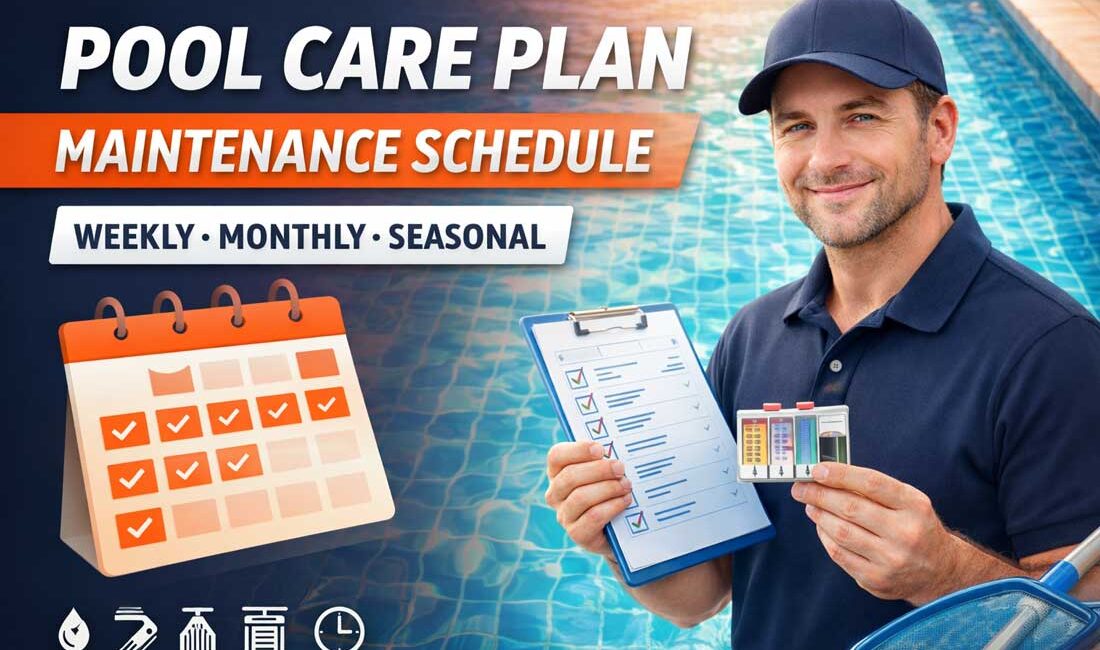
Dreaming of owning a pool often involves visions of jumping into crystal-clear water with a cold drink in hand on a hot summer day. However, reality can sometimes overshadow this dream with cloudy water, burning eyes, and endless cleaning sessions. If you want to be the master of your pool rather than its slave, the only thing you need is a solid, actionable pool maintenance schedule.
Acting without a plan constantly pushes you to chase after problems; whereas a well-constructed calendar prevents problems before they even arise. In this article, without diving into complex chemistry lessons, we will discuss step-by-step how to keep your pool sparkling throughout the season and how to put the maintenance process on autopilot. If you are ready, let’s start turning chaos into order.
Weekly Pool Maintenance Checklist
Weekly maintenance is the backbone of pool health. If you neglect your weekly pool maintenance schedule, minor issues can turn into a giant green nightmare by the weekend. There is no need to make this process bigger than it is; if you follow the right steps, it won’t even take an hour in total. Here is what you must do every week:
- Skimming: First, take your net and collect leaves, insects, and pollen from the water surface. If this debris is removed before it sinks to the bottom, the water chemistry won’t be disrupted, and stains won’t form.
- Brushing: You should brush the pool walls, steps, and especially the corner points. Algae start to cling to surfaces before they become visible; brushing mixes them into the water so the filter can catch them.
- Vacuuming: Use a manual vacuum or, if you have one, a robot to pool clean sediments that have settled on the pool floor.
- Chemical Testing and Balancing: Use your test kit to measure pH (7.2-7.6) and Chlorine (1.0-3.0 ppm) levels. If the pool chemistry is unbalanced, make the necessary additions. Remember, balance is everything.
- Shocking (If Necessary): If the pool has been used very heavily or the water has started to look dull, burn off dead bacteria and organic waste by chlorine shocking.
- Filter Check: Check the pressure gauge. If it is 10 psi above normal, relieve the filter by backwashing.
What Makes a Good Pool Maintenance Schedule?
A perfect swimming pool maintenance schedule should be a system that makes your life easier, not one that tires you out. First of all, the schedule needs to be sustainable. If you burden yourself with a daily pool maintenance load that is too heavy to apply, you will give up after a while, and things will get out of hand. A good schedule should also be flexible; you should be able to revise the calendar after a rainy day or a crowded party.
Additionally, a disciplined habit of record-keeping determines the success of the schedule. By keeping a pool log book, you should note down how much chlorine you added and how the pool pH value changed on which day. These records will act as a detective for you in finding the source of chronic problems you might experience in the future. Finally, a regular pool maintenance schedule should focus not only on cleaning but also on equipment health. Looking only at the water is not enough; the sound of the pump, the pressure of the filter, and the condition of the valves should also be part of this schedule. The goal is not just to save the day but to extend the life of the pool.

Pool Maintenance Schedule Pdf
Even though we love technology, having a tangible template at hand in the pool room or pump room always speeds things up. A printable checklist that you can find on the internet or create yourself is the best medicine against forgetfulness.
By downloading and printing a Pool maintenance schedule Pdf file, you can put it in a transparent file or laminate it to make it waterproof. Hanging this list on the door of the pump room allows both you and others taking care of the pool (family members or the gardener) to see which step is next. A list with easy-to-follow, checkable boxes simplifies complex processes. Visual memory is important; seeing what you need to do on paper clears your mind and eliminates the stress of “Did I add the chlorine?”.
Saltwater Pool Maintenance Schedule
Although saltwater pools require less intervention than chlorinated pools, they do not operate entirely on a “leave it be” logic. The best saltwater pool maintenance schedule centers on the health of the salt cell (generator). In these systems, salt is what produces the chlorine, so you must regularly check the salt level.
- Cell Check: Calcification (calcium buildup) is the biggest enemy of the salt cell. Removing the cell every three months and cleaning it with acidic water extends the life of the system.
- pH Monitoring: The most important detail to pay attention to when doing saltwater pool maintenance is that the salt generator tends to raise the pH level while working. Therefore, the use of pH reducer (acid) is more frequent in these pools.
- Sacrificial Anode: Saltwater is prone to corrosion. You should check the zinc anodes (sacrificial anode) used to protect the metals in the pool once a year and replace them if they have melted.

Above Ground Pool Maintenance Schedule
Since above-ground pools generally have weaker circulation systems, the risk of water remaining stagnant is higher. Therefore, the keyword for a trouble-free pool maintenance schedule is “circulation”.
- More Frequent Brushing: Dead spots (corners where water does not turn) are algae nests. You should brush at least twice a week in above-ground pools.
- Chlorine Tablets: Tablets you place in the skimmer basket or floating dispenser provide continuous disinfection. However, you should check daily to replenish when the tablets run out.
- Cartridge Filter Cleaning: Generally, cartridge filters are used in these pools. Even if the pressure does not increase, removing the cartridge once a week and washing it with pressurized water preserves the clarity of the water.
Inground Pool Maintenance Schedule
Inground pools require a more comprehensive approach due to larger water volumes and complex piping systems. Here, general pool maintenance procedures also include monthly and annual heavy maintenance.
- Skimmer and Main Drain: Inground pools have a main drain line. You must ensure that water is suctioned from both the top and the bottom.
- Water Level: If the water level drops below the skimmer mouth after evaporation or backwashing, the pump will suck air and may burn out. Always keep the water level at the halfway mark of the skimmer.
- Stain Control: Metal stains or lime deposits can form in concrete pools. Using stain-preventing chemicals once a month preserves the cosmetics of the pool.
- Professional Water Analysis: Take a water sample to a professional pool specialist at least twice a season to measure metal, phosphate, and cyanuric acid values.
Chlorinated Pool Maintenance Schedule
The biggest misconception in traditional chlorinated pools is that just adding chlorine is enough. However, for chlorine to work, you must also be the guardian of other values. This is the most basic rule serving as a guide for beginners in pool maintenance.
- Cyanuric Acid (Stabilizer): Prevents chlorine from flying away in the sunlight. If this value is low, the chlorine you add will disappear within hours. The ideal range is 30-50 ppm.
- Combined Chlorine: If you smell a strong chlorine odor in the pool, this is not due to too much chlorine, but due to “spent” dead chlorine (chloramines) turning into gas. In this case, you must burn off this dead chlorine by shocking.
- Weekly routine must include the use of algaecide. Chlorine kills algae, while algaecide prevents it from forming. They have different duties.

Indoor Pool Maintenance Guide
Although an indoor swimming pool is protected from external factors (rain, leaves, sun), it has its own unique challenges. Since the sun’s UV rays do not touch the water, chlorine does not disappear naturally, and oxidizing by-products accumulate in the pool room.
- Ventilation: The most critical issue is air quality. Chloramines mix into the air, and if there is no good ventilation system, it leads to corrosion and respiratory problems.
- Shocking Frequency: Since there is no UV light, you must shock more frequently (without oxygen) compared to outdoor pools to break down combined chlorine.
- Humidity Control: The humidity in the environment should be kept in the 50-60% range. Otherwise, mold forms on the walls, and the pool water balance is disrupted.
- Algae Risk: Since it does not see the sun, the risk of algae is lower, but since the water temperature is generally higher, bacterial growth can accelerate. Keep the temperature under control.

Other Articles

How To Backwash A Pool
Low Alkalinity In Pool

2 Comments
Comments are closed.
